When travelers look towards Macau, the images that most readily come to mind are those of dazzling casinos, opulent resorts dominating the skyline, boutiques where luxury is the only standard, and restaurants meticulously directed by Michelin-starred chefs. Yet, this tiny Asian peninsula, so often synonymous with glitz and excess, guards within its winding streets and historic squares a secret that remains largely undiscovered by many international visitors. Beyond the opulence lies a unique cultural legacy, the fruit of over five centuries of encounter between East and West.
In Macau, Chinese traditions interweave with the Portuguese legacy in a singular manner that is palpable in every corner of the old city. Centuries-old churches, boasting baroque facades and intricate blue-and-white azulejo tile details, coexist harmoniously with Buddhist temples where the aroma of incense perfumes the air and ancient pagodas rise in majestic calm. The cobblestone streets, which serve as witnesses to the passage of time, wind between vividly colored colonial buildings and traditional markets where the bustle of daily life appears unchanged for decades.
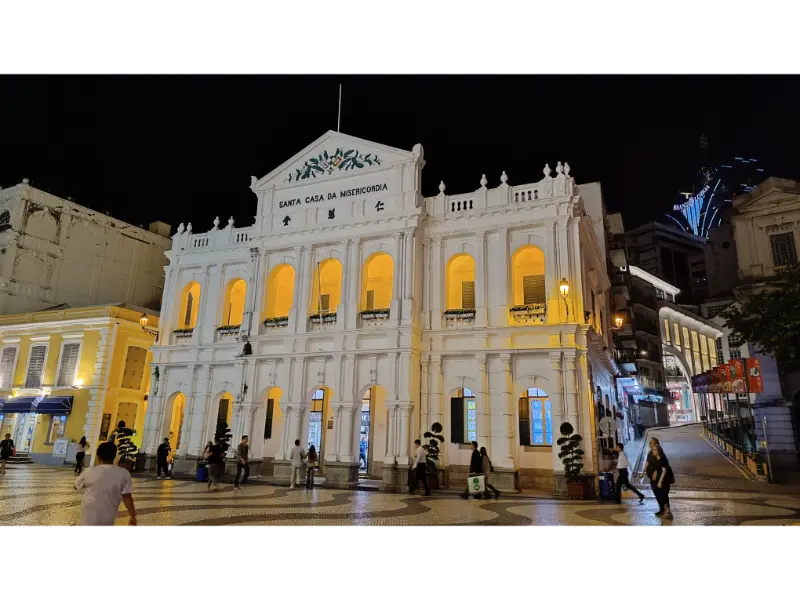
The Largo do Senado (Senate Square) serves as the civic heart of Macau, anchoring the most notable buildings reflecting the Portuguese presence on the peninsula. The square features the traditional Portuguese calçada—a mosaic of patterned cobblestone paving—creating an atmosphere that transports visitors instantly to a nostalgic corner of Lisbon. This grand explanada is presided over by the former Leal Senado, the municipal chamber established in 1583. Directly facing it are the historic font, the Holy House of Mercy, and nearby, the Cathedral.
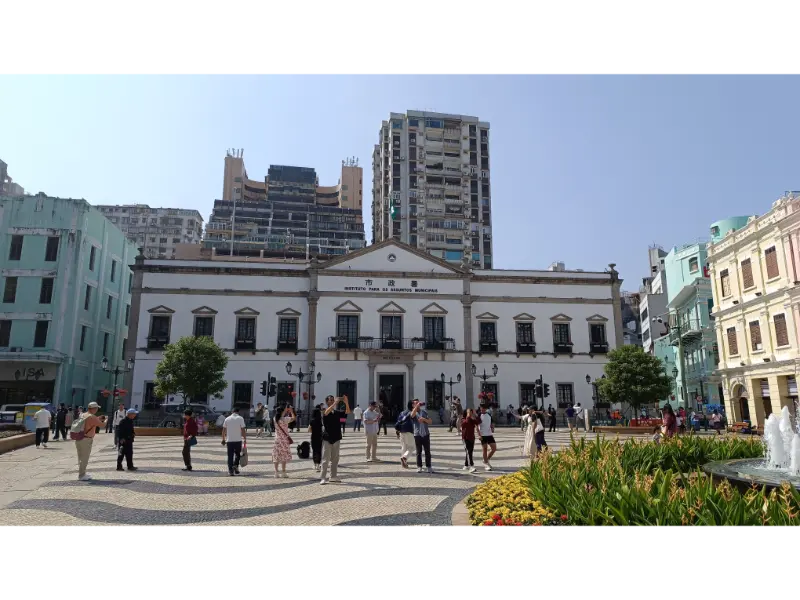
At the other end of the Largo lies the iconic 16th-century St. Dominic’s Church, a stunning example of Portuguese Baroque architecture. It is flanked by the St. Dominic’s Market, constructed in the 19th century. This market, also known as the central market, was long considered one of the nostalgic centers of the city and remains one of the best locations to enjoy authentic local food. Here, an ample selection of simple, homemade dishes allows visitors to dine affordably while taking in a 360-degree panoramic view of the city center.
Gastronomy is where this extraordinary cultural blend comes to life with the greatest intensity. Macau is a true melting pot of flavors, where Cantonese and Portuguese influences fuse in unique ways. Emblematic dishes like arroz chau chau combine fresh local ingredients with Chinese culinary techniques, sharing the menu with Portuguese classics like bacalhau à brás, adapted over centuries to local tastes. And no visit is complete without sampling the star dessert: the pastéis de nata, whose creamy texture and delicate, crispy base delight both locals and visitors. This culinary diversity not only reflects Macau’s unique cultural mestizaje but also establishes it as an incomparable gastronomic destination.
“Gastronomy is where this extraordinary cultural blend truly comes alive, creating a unique melting pot of Cantonese and Portuguese flavors.”
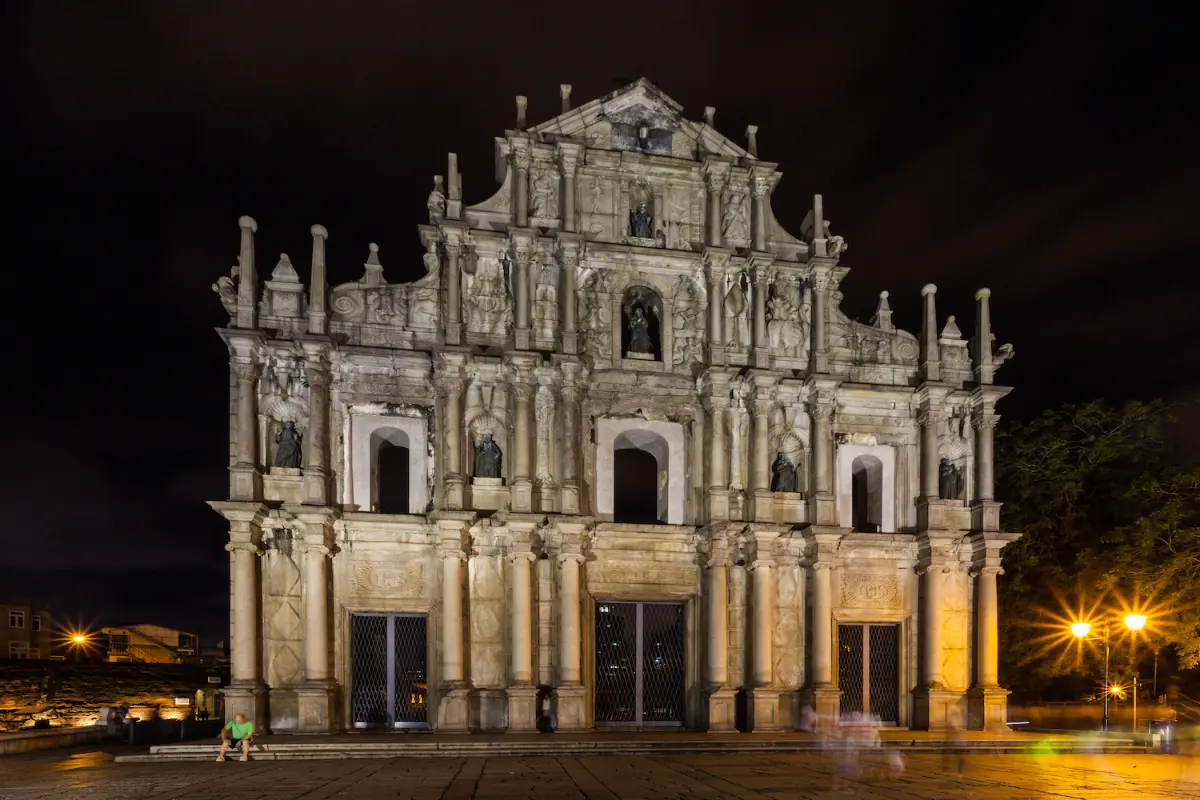
Continuing the journey northward along Rua de São Paulo, the most iconic emblem of Macau rises before us: the Ruins of St. Paul’s. Originally a grand 17th-century church built by Jesuit missionaries, this monument symbolizes the grand historic encounter between East and West. Its imposing facade, masterfully carved from granite, is all that remains standing after a devastating fire destroyed the rest of the structure in 1835. The elaborate relief ornamentation tells the history of this unique cultural crossroads.
Figures of Catholic saints intertwine with Chinese dragons and Japanese characters on the facade, recalling Macau’s historic role as a bridge between continents and beliefs. Directly adjacent, the Museum of Macau, situated within the Mount Fortress, offers a window into the intimate past of the neighborhood. Through artifacts and archival photographs, visitors can immerse themselves in Macau’s transformation over the centuries, before ascending to the fortress terrace to admire the city from the Monte do Forte, where remains of the ancient fortification still stand.
“Figures of Catholic saints intertwine with Chinese dragons on the facade of St. Paul’s, masterfully carved granite that symbolizes the historic bridge between continents.”
A few steps from the Ruins of St. Paul’s, yet away from the bustle of the historic center, lies the charming Lilau Square. This space captures the essence of Portuguese influence, surrounded by traditional pastel-colored houses and Mediterranean-style shuttered windows. The square was once the epicentro of daily life for the city’s early Lusitanian residents. It owes its name to a natural spring that, for centuries, supplied water to the local population.
A popular Macanese saying reflects the emotional bond to this serene spot: “Quem bebe a água de Lilau, nunca mais esquece Macau” (He who drinks the water of Lilau will never forget Macau). This symbolic detail reinforces the nostalgic and cultural character of the square, which remains a quiet meeting point. Strolling through Lilau is to enter a slower, more melancholic Macau. The cobblestone paths and soft murmur of neighboring conversations contrast sharply with the accelerated rhythm of the nearby casinos.
Following the Rua da Barra, the A-Ma Temple appears, marking the spot where the Portuguese first disembarked in the mid-16th century. Dedicated to Mazu, the goddess of the sea and protector of fishermen, it stands as a symbol of Chinese spiritual identity. As one of Macau’s oldest sanctuaries, it offers a living testimony to the deep connection the city maintains with the sea and its maritime traditions.
“Lilau Square captures the essence of Portuguese influence, offering a nostalgic and tranquil contrast to the accelerated rhythm of modern casinos.”
From the upper gardens of the A-Ma Temple, one’s gaze extends toward other emblematic corners of Macau, such as the Capela de Nossa Senhora da Penha and the Miradouro de Santa Sancha. Perched atop a hill, the Capela de Nossa Senhora da Penha offers a haven of tranquility far from the urban bustle. Originally constructed in 1622 by Portuguese sailors seeking the Virgin’s protection, the chapel serves as both a spiritual refuge and a dramatic natural viewpoint.
From its placeta, the views encompass the Macau harbor and the Friendship Bridge (Ponte da Amizade), an emblem of the connection between the islands. Not far from the chapel lies the Miradouro de Santa Sancha, situated adjacent to the official residence of the Chief Executive of Macau. This viewpoint is less frequented than other tourist spots, making it a well-kept secret. It invites quiet contemplation of how Macau, with masterly balance, manages to harmonize its deep historical heritage with vibrant modernity across the coast.