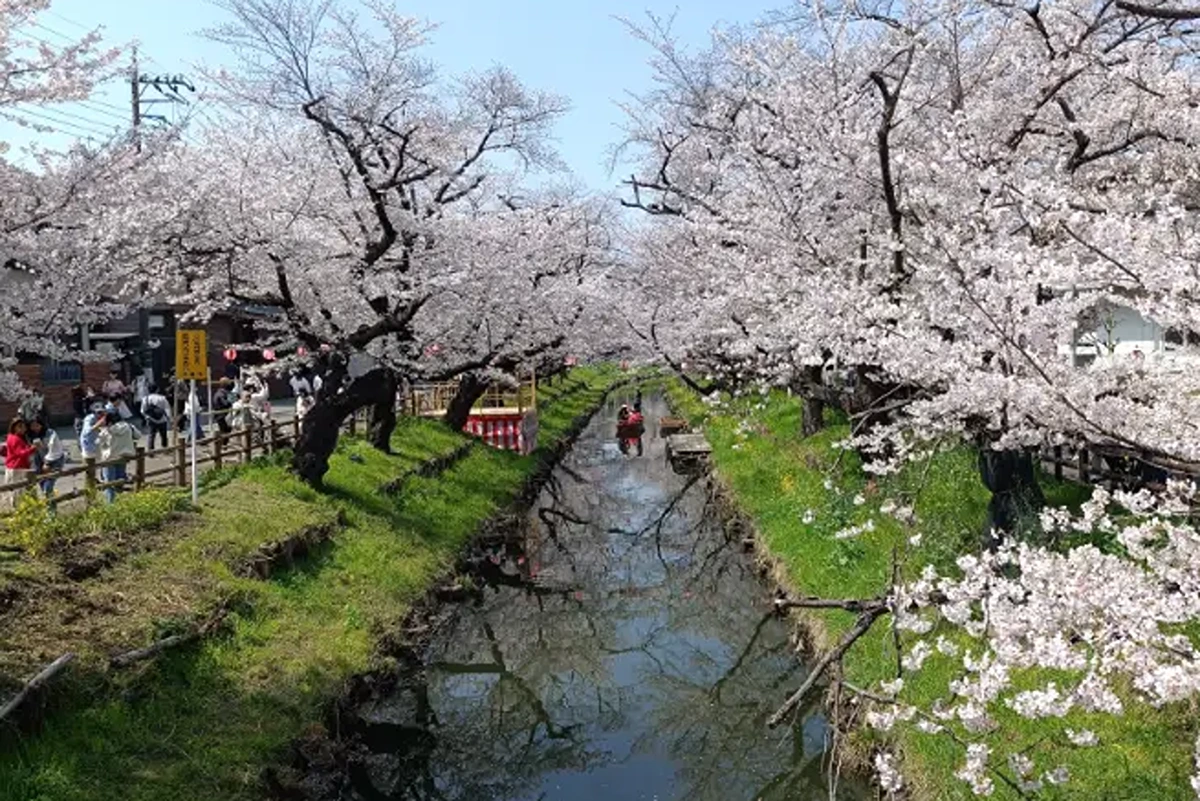
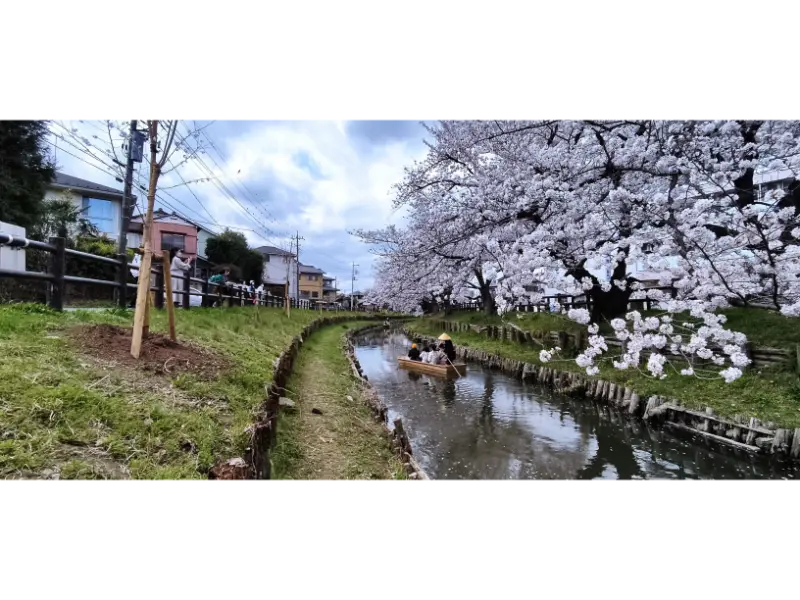
In the early afternoon, Hikawa Bridge transforms into an improvised cinematic stage. Groups of young women, draped in soft-toned kimonos, laugh while attempting to catch the slow-motion rain of petals falling over the water. Beneath them, small wooden boats glide calmly along the Shingashi River, navigating through white and pink speckles floating on the surface. On the banks, the blooming cherry trees trace an ephemeral tunnel, turning Kawagoe into a living postcard of Japan’s most evocative season.
Just meters from the bridge, the grand torii of Hikawa Shrine—one of Japan’s most imposing—stands as a symbolic gate between the tourist buzz and a sanctuary of stillness. The intense red of the wood contrasts sharply with the pinkish-white of the sakura in a choreographed composition. Beside it, the shrine of Kakinomoto no Hitomaro, dedicated to one of the immortal poets of classical Japan, provides a discreet and singular presence. The proximity of the river and the concentration of temples make this stretch one of the most memorable spots during the flowering season.
This historical memory is surprisingly accessible. A train on the Tobu Tojo line pierces Tokyo’s concrete for thirty minutes to open up into the quieter horizons of Saitama, leaving the traveler just a short walk from these bridges and shrines. Efficiency places serenity just a handful of minutes away from the urban roar, proving that the frantic pace of the capital has a nearby antidote that feels centuries away.
It is no coincidence that Kawagoe is known as “Little Edo.” Less than an hour from Tokyo, this city in Saitama Prefecture preserves streets of dark wood warehouses, thick-walled facades, and a bell tower that recalls an era when time was marked by bronze rather than screens. The nickname is not a mere tourist label; it refers to the Edo Period (1603-1868), an era of political stability under the Tokugawa shogunate when Tokyo became the most populous city in the world.
“Kawagoe does not merely imitate the past; it allows tradition to survive by maintaining its core identity as the historic pantry of the capital.”
That dynamic capital, which exceeded one million inhabitants by the 18th century, required a constant supply of goods. Kawagoe, strategically located to the north and connected by fluvial routes and commercial roads, consolidated itself as a key distribution center for agricultural and artisanal products. Its warehouses—today admired visual icons—were not a stage set but the “great pantry” of the capital: spaces designed with thick walls to protect merchandise from the frequent fires that devastated pre-industrial Japanese cities.
During the cherry blossom season, this legacy acquires a scenographic dimension, yet its presence is the fruit of genuine historical continuity. Kimono-clad youth stroll among centennial houses, while tourists and residents share the same ritual of contemplation. What is perceived as “atmosphere” is, in reality, the continuity of a historical relationship with Edo. Kawagoe does not imitate the past; it allows tradition to survive by maintaining its own unique identity.
In the Nakain district, the rhythm shifts again. Here, the protagonists are the weeping cherry trees, with branches falling like light curtains over the temple paths. On the Kantō plain, these trees possess an especially enveloping presence, and during the bloom, the scene achieves a hypnotic beauty—a cascade of petals transforming the temple into a space for slow contemplation. As evening arrives, soft lighting modulates the space into a suspended scene where time seems to slow down.
The Shingashi River offers a more introspective perspective. Boats advance without haste under cherry trees leaning over the yellow of the rapeseed flowers, and the noise of the street is muffled by the water. From here, the trunks seem taller and the branches closer, turning the walk into a simultaneous gaze upward at the pink-tinted sky and downward at the river surface, which patiently collects whatever falls from the branches.
When these petals accumulate and form a compact surface sliding downstream, the Japanese call it hanaikada, or a “flower raft.” It is the image of a moment when the peak has passed but beauty persists in a different form. The river does not take spring away; it displaces it. In this slow movement lies a way of understanding time that privileges acceptance over resistance, welcoming the end with serenity. This consciousness that fullness includes its own ending permeates Japanese aesthetics.
“The river does not take spring away; it displaces it, embodying a Japanese aesthetic that welcomes the end of the bloom with serenity rather than resistance.”
The practice of hanami, literally “looking at the cherry blossoms,” dates back to the Heian period (794-1185), when the imperial aristocracy organized banquets under the flowers. Over centuries—and especially during Edo—the celebration extended to urban classes, coinciding with the growth of a citizen culture that made leisure and the changing seasons a shared ritual. Even today, the bloom marks the collective calendar, with the Meteorological Agency publishing a forecast map that moves from south to north like a pink wave.
In Kawagoe, hanami is often a domestic, understated affair. People sit with a discreet blanket by the river; students share canned drinks under the trees; grandparents watch in silence as grandchildren collect petals by the handful. The scene is not exceptional or solemn; it is familiar. Perhaps it is this very normality that gives the celebration its meaning, proving that the most profound rituals are those integrated into daily life.
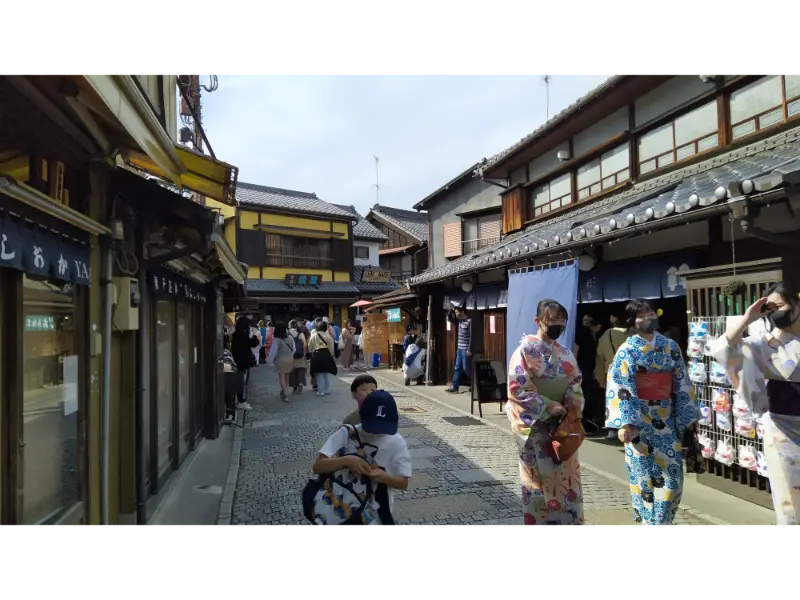
The historic center is dominated by the kurazukuri houses, the thick-walled warehouses that defined the city’s skyline. These facades project a silent solidity that contrasts with the lightness of the cherry blossoms. Walking here requires attention to detail: the wooden signs, the textures that conserve commercial memories of centuries past. In the midst of this stands the Toki no Kane, the “Bell of Time,” which has marked the civil rhythm of the city for merchants and neighbors since the Edo period.
Kawagoe’s architectural survival is a lucky accident of history. The city did not suffer the massive aerial bombardments that leveled Tokyo during World War II. While Tokyo had to reinvent itself in concrete and asphalt to become the Olympic showcase of 1964, Kawagoe could afford not to rush. It preserved its wood and ancient layout simply because there was no urgent need to change, allowing today’s visitor to walk through a tangible fragment of pre-industrial Japan.
In a context of growing international tourism—with millions of visitors saturating sites like Kyoto—Kawagoe offers a different scale. While popular in the spring, it still allows for a walk without the feeling that the landscape is merely a backdrop for social media. Its strength lies in its proportion: the possibility of moving between the river and the shrines without the crowd entirely diluting the perception of the place.
“Kawagoe’s survival is a lucky accident of history; having escaped the bombings of WWII, it allows today’s visitor to walk through a tangible fragment of pre-industrial Japan.”
Kawagoe does not compete with the grand stages of Kyoto or the intensity of Tokyo; it nuances them. It offers a spring that allows itself to be inhabited without urgency, where the bloom is lived as a measured experience. This serenity is the result of an urban scale that has not yet been overwhelmed. In a country where modernization has been dizzying, Kawagoe reminds us that beauty does not always need spectacularity to endure, but rather the attention of those who witness it.