Walking through Intramuros today, in the heart of Manila, is to traverse a city originally designed for dominance that ultimately fueled the very concept of liberty. For centuries, the named Pearl of the Orient was synonymous with colonial power, serving as the formidable stronghold of Spanish rule in Asia. Yet, within these same formidable walls, gestated a consciousness of resistance and national awakening that survived the devastating occupation by foreign powers, first Spanish and later Japanese.
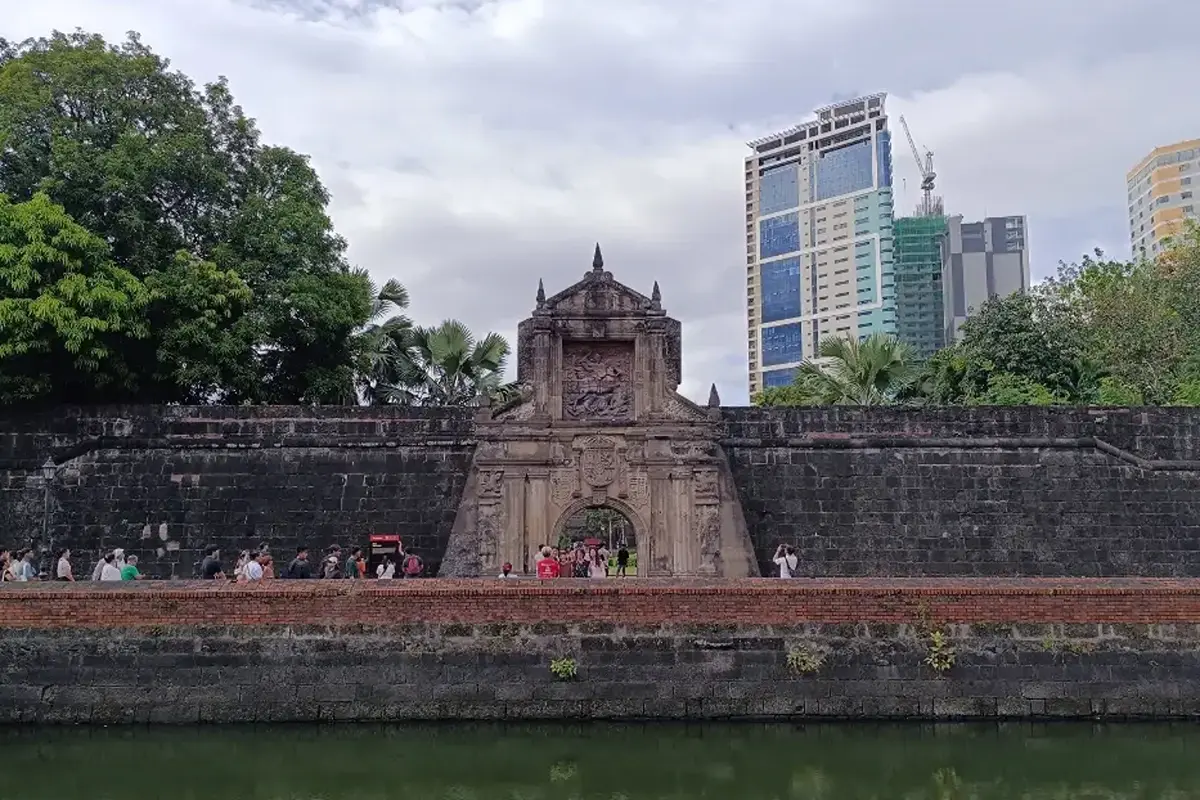
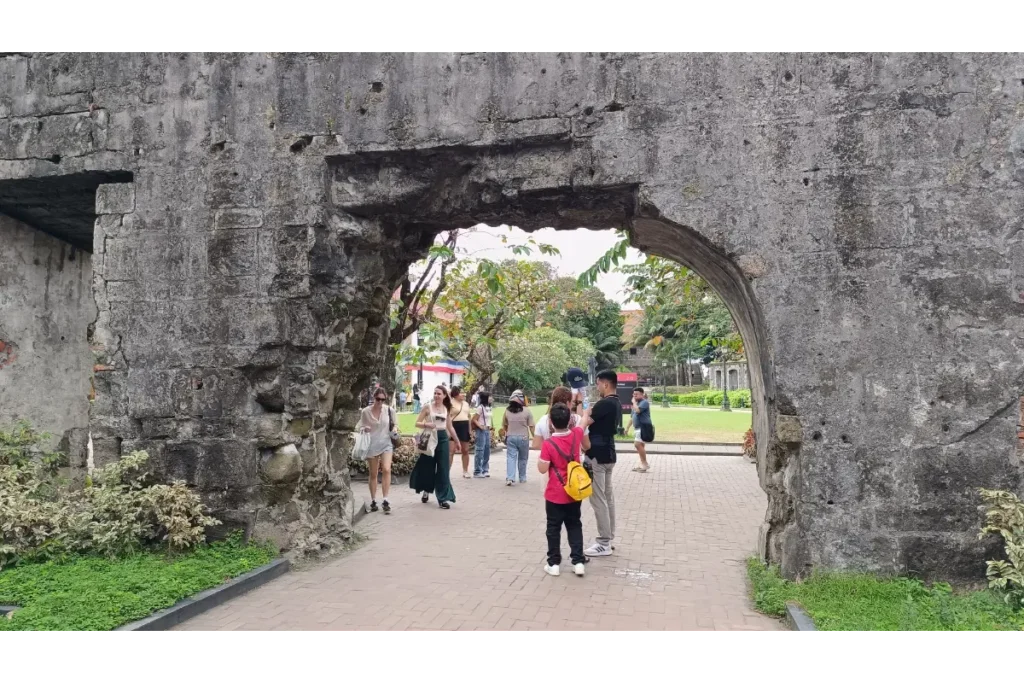
Today, Intramuros remains one of the few spaces within the sprawling metropolis of Manila where time appears to flow at a different cadence. Imprisoned between coral stone walls, bastions, churches, and hidden inner courtyards, visitors traverse a city designed specifically to be walked, far removed from the chaotic traffic of the modern surrounding capital. Heritage carriages, museums, intimate cafés, and restored buildings now coexist with the visible scars of widespread destruction during World War II, a somber reminder that what is offered today as heritage attraction is also a poignant landscape of reconstructed ruins.
The urban layout of Intramuros responds to a specific European military logic imported to Asia during the 16th century through navigation and military engineering. Within this context, sailors and builders from the Basque region played a prominent role. Miguel López de Legazpi, a native of Zumárraga, not only founded the city in 1571 but actively participated in implanting an urban model specifically conceived to control vital maritime routes and administer a vast colonial territory across the Pacific. In this sense, Intramuros cannot be fully understood without acknowledging this naval tradition, even if its material legacy is inevitably bound to a foreign imperial project.
For over three centuries, Intramuros was not merely a walled city but a functioning device of colonial control. Within its fortifications concentrated the political, military, and religious power of the Spanish Empire in the Philippines, while the indigenous population was largely excluded from this fortified space. The streets, grand churches, and administrative buildings were not conceived to protect the city itself, but rather to protect the power inhabiting it, establishing a physical and symbolic border between those who governed and those who were governed.
That very border began to crack in the late 19th century, when Intramuros also became the somber stage of repression that would ultimately fuel the vibrant Filipino independence movement. José Rizal, a prominent physician, author, and enlightened thinker, was incarcerated in one of its prisons. Paradoxically, Rizal did not call for independence but rather defended political reforms, education, and civil rights within the colonial framework. Having studied in Manila and several European cities, Rizal represented a unique Filipino intellectual elite aspiring for legal equality and cultural recognition rather than a violent rupture with Spain.
The execution of José Rizal in 1896 marked a definitive point of no return, proving devastating for the colonial regime itself. By eliminating a moderate, cultured, and eloquent figure, the Spanish authorities involuntarily transformed a reformist intellectual into a powerful martyr. His death radicalized the emancipation movement, converting his memory into the catalyst for a national awakening. In this manner, Intramuros, originally conceived as a symbol of colonial order and absolute control, transitioned into an uncomfortable space for the imperial narrative, transforming from the scenario of Spanish dominance into the very site fueling open struggle for independence.
“Authorities involuntarily transformed a moderate intellectual into a powerful martyr, radicalizing the emancipation movement and converting Intramuros from a symbol of colonial control into the scenario fueling open struggle for independence.”
The end of Spanish rule in 1898 did not bring immediate independence for the Philippines. Following the Spanish-American War, the archipelago passed into the hands of the United States, which instituted a new form of colonial occupation wrapped in a discourse of modernization, education, and political tutelage. Intramuros, which had served as the heart of Spanish power in Asia, progressively lost its administrative centrality but continued to function as a symbolic space of authority within a Manila that was beginning to reconfigure itself under political and urban parameters imposed from Washington.
The WWII years gravely exacerbated the nation’s fragility. The Japanese occupation converted Intramuros into headquarters and prison, and the devastating Battle of Manila in 1945 sealed its tragic fate. During the process of “liberation” carried out by American forces, the historic center was practically flattened, and thousands of civilians lost their lives. The Pearl of the Orient was reduced to ruins, a victim of a war between empires in which the Philippines was once again the setting, rather than the subject, of its own history.
“WWII Japanese occupation converted Intramuros into headquarters, and the devastating 1945 Battle of Manila reduced the Pearl of the Orient to poignant reconstructed ruins.”
After the war, Intramuros did not return as the political heart of the country, yet it was not abandoned to its fate. During the ensuing decades, its poignant ruins coexisted with an expanding modern city looking more toward the future than its past. Under the dictatorship of Ferdinand Marcos (1965–1986), the regime used historic heritage as a symbolic tool. The partial reconstruction of Intramuros formed part of a nationalist legitimization strategy seeking to project an image of historical continuity and order, while simultaneously repressing political dissent in other spaces across Manila.
It was within this context that the Intramuros Administration was created, the body tasked with supervising the restoration of the walled precinct. The process was not without controversy: the reconstruction often prioritized an idealized image of the Spanish colonial past, occasionally closer to a tourist postcard than the historic complexity of the site. Nonetheless, Intramuros began to recover its urban layout, grand churches, bastions, and walls, once again becoming a recognizable space within Filipino collective memory.
“Reconstruction often prioritized an idealized image of the Spanish colonial past, yet Intramuros regained its urban layout, churches, and bastions, once again becoming a recognizable space within Filipino collective memory.”
The fall of Marcos and the recovery of democracy following the 1986 People Power Revolution opened a new chapter. Intramuros then transitioned from being an instrument of the official narrative to a space of critical resignification, where the colonial past, anti-Spanish resistance, Japanese occupation, and the fight for liberties could be read critically. Today, the cobblestone streets and rebuilt walls are no longer solely a historic backdrop but a stage for debates on identity, memory, and sovereignty.
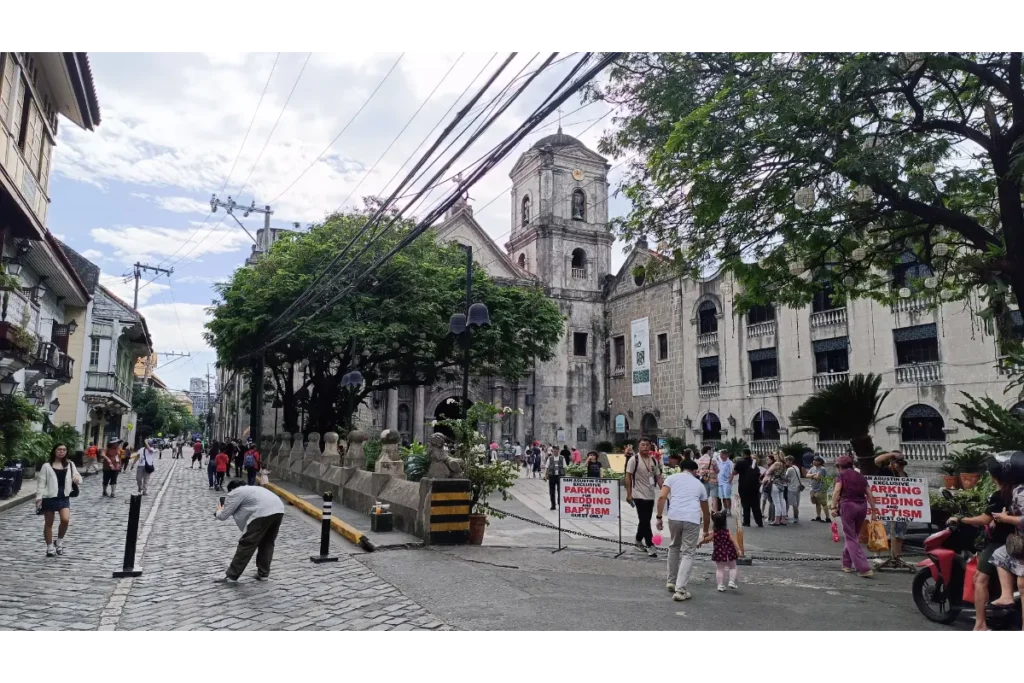
San Agustín Church, designated a UNESCO World Heritage site in 1993, remains a central pillar of this resignified Intramuros. Exploring the historic center, whether by heritage bicycle or strolling along the bastions at sunset, offers an experience combining leisure, history, and pedagogy. Beneath the pleasant surface, the precinct continues to interpellated the visitor: every rebuilt stone serves as a reminder that the past has not been erased, but rather interpreted, and that memory is also a continuous political construction.
Intramuros represents a persistent paradox for the Philippines—simultaneously a symbol of foreign dominance and of national awakening; a space of oppression and of emancipation; a ruin of war and a project for the future. Its preservation poses critical questions regarding heritage and memory especially in a nation marked by successive centuries of foreign occupation. The fact that Intramuros was founded in 1571 by Miguel López de Legazpi, a Basque serving the Spanish Crown, remains a significant detail. From here, Spanish colonial power was projected across Asia for centuries; but from this very precinct gestated the critical consciousness that would ultimately fuel Filipino independence. Today, transformed into heritage space and living memory, Intramuros reminds us that empires are constructed, but they are also eroded, and that cities born to dominate can ultimately end as powerful symbols of resistance, identity, and recovered sovereignty.